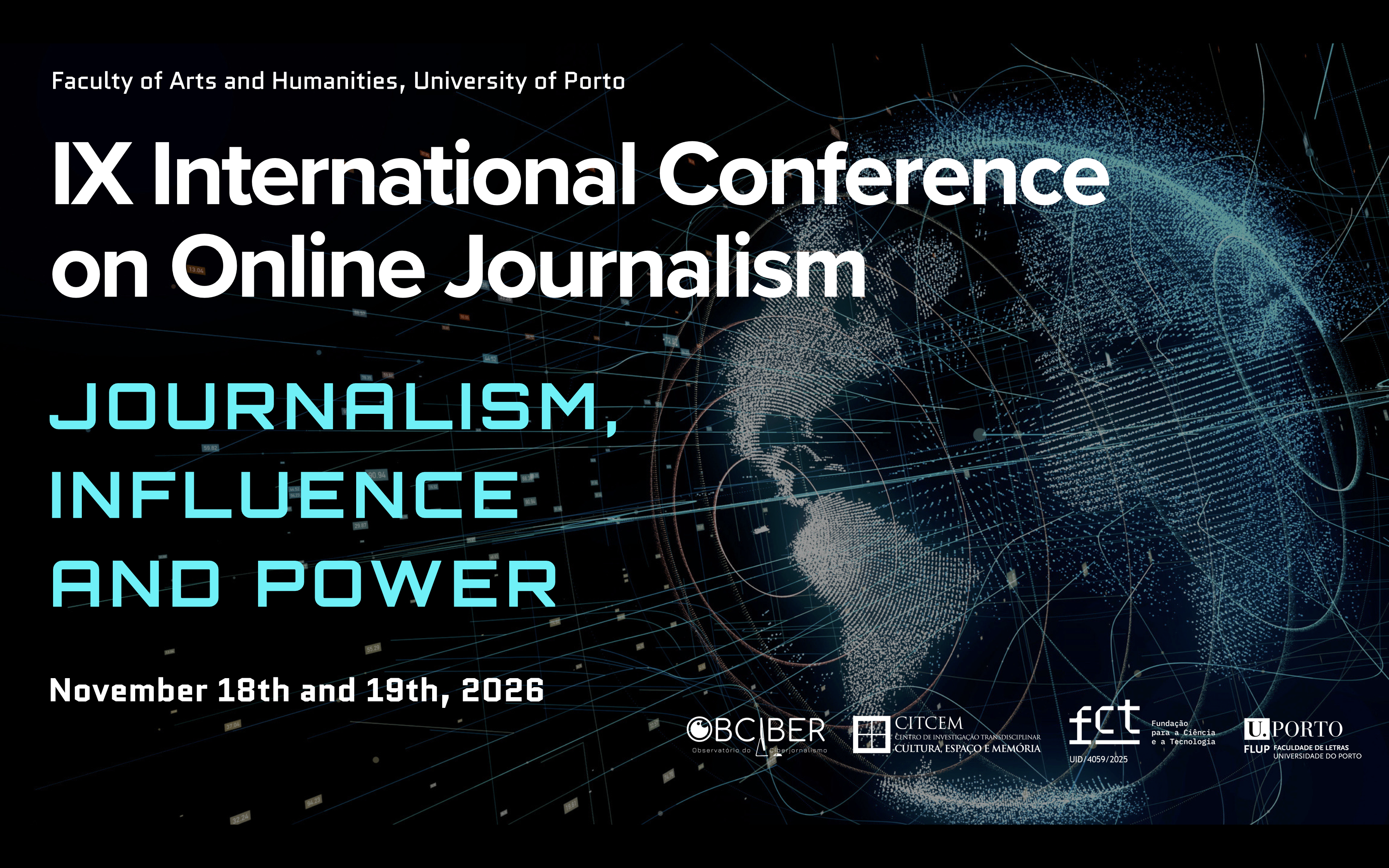
Call for abstracts and panels
The organizing committee of the IX International Conference on Online Journalism (#9COBCIBER) invites interested researchers
to submit proposals to be presented at the Conference, taking place on 18 and 19 November 2026,
at the Anfiteatro Nobre of the Faculty of Arts and Humanities of the University of Porto.

Throughout its various editions, the International Conference on Online Journalism has followed the transformations
 of journalism in the digital environment, from the first experiments in participation and convergence to the current challenges
posed by platformisation and artificial intelligence. In this journey, it has established itself as a space for critical reflection
on emerging practices, models and dynamics in the field of cyberjournalism.

The 2026 edition proposes to shift the analytical gaze towards the relationships of influence and power that run through
the digital information ecosystem. Rather than introducing new objects of study, the aim is to encourage a critical reading of
how power is distributed, negotiated and exercised in the processes of information production, circulation and reception.
In this context, platforms, algorithms, political actors, content creators, metrics and emerging technologies cease to be merely
elements of the media system and are instead analysed as active agents in shaping informational visibility, authority and legitimacy.
 With this in mind, submissions should address cyberjournalism, with a particular focus on this edition's theme,
"Journalism, Influence and Power", and may cover, among others, the following topics:


- Journalism, platforms and the reconfiguration of informational power
- Digital influence, content creators and new mediators of current affairs
- Political power, propaganda, strategic communication and journalism
- Disinformation, manipulation and influence operations in the digital public sphere
- Artificial intelligence, automation and the redistribution of journalistic authority
- Algorithms, visibility and attention hierarchies
- Business models, monetisation and economic dependencies of digital journalism
- Metrics, performance and editorial constraints
- Regional and local journalism: proximity, legitimacy and power relations
- Communities, participation and forms of mediated public engagement
- Credibility, trust and disputes over informational legitimacy
- Ethics, transparency, regulation and accountability in the digital ecosystem


Proposals, in the form of an extended abstract, may be written in English, Portuguese, Spanish or French.
Each submission should be between 400 and 500 words and must include, in particular, the identification
of the topic and its relevance, the central hypothesis or argument, the theoretical and methodological framework,
expected results, and up to five keywords.

Proposals must be submitted via a dedicated online form, by 30 June 2026.

Call for panels

This year, the International Conference on Online Journalism also opens the possibility of submitting thematic panels,
aligned with the general theme of this edition, "Journalism, Influence and Power". The panels aim to stimulate collective
and in-depth debate around specific issues in contemporary online journalism, promoting the participation of research networks,
collaborative projects, and national and international working groups. Panel proposals should be articulated with the Conference topics
and may focus, among other possibilities, on the relationships between journalism, platforms, influence, artificial intelligence,
political power, disinformation, metrics, digital communities, regional and local journalism, informational legitimacy,
or the transformation of professional practices and mediation models. Each panel should include between
4 and 6 participants, including a coordinator/moderator, and will have an expected duration of 60 to 90 minutes.
Proposals should include:

- panel title;
- general summary of the proposal (400 to 500 words);
- identification of participants and their institutional affiliation;
- title and brief abstract of each contribution.

Panel proposals should also be submitted by 30 June 2026, via the same form.

The evaluation of proposals will be carried out by the Scientific Committee of #9COBCIBER,
with results communicated to authors by 31 July 2026.

Full papers must be submitted by the date of the Conference. Selected works may be included in
subsequent scientific publications, in formats to be defined, and will be subject to a new review process.

#9COBCIBER will be held in person on 18 and 19 November 2026, and online on the afternoon of 18 November,
at the Anfiteatro Nobre of the Faculty of Arts and Humanities of the University of Porto.

The Conference is organized by ObCiber - Cyberjournalism Observatory,
CITCEM - Transdisciplinary Research Center for Culture, Space and Memory and
FLUP - Faculty of Arts and Humanities of the University of Porto.
Timetable
Opening of the call for papers (extended abstracts): 07.04.2026

Call for abstracts close: 30.06.2026

Communication of results: 31.07.2026

Closing of the 1st registration phase: 30.10.2026

Closing of the 2nd registration phase: 13.11.2026

Congress: 18 e 19.11.2026

Deadline for submitting full articles: 18.11.2026
Programme
November 18th (Wednesday)
8:30 am – Registration open
9:00 am – Opening Session
09:30 am – Opening Conference
“From fact-checking to trust-building: Negotiating journalistic roles and authority in times of crisis”
David Blanco Herrero (University of Amsterdam, Netherlands)
Session chair: Helder Bastos (FLUP)
10:30 am – Coffee Break
10:45 am – Panel “Ethics, transparency and regulation in digital news: the EuroMO 2025 experience”
Bissera Zankova, Media 21 Foundation, Bulgaria (coord.)
Achilleas Karadimitriou, Panteion University of Social and Political Sciences, Greece
Elsa Costa e Silva, University of Minho, Portugal
Ivo Indzhov, independent researcher, Bulgaria
11:45 am – Communications Session 1
Disinformation in digital media as a disaster booster: the case of Nova Friburgo, Rio de Janeiro State, Brazil
Monique Sampaio & Victor Marchezini (Instituto Nacional de Pesquisas Espaciais; Centro Nacional de Monitoramento e Alerta de Desastres Naturais)
Gendered Disinformation in Electoral Campaigns: Narrative Frames in Croatia’s 2024–2025 Super-Election Cycle
Josip Sipic & Iva Zelic (CESI – Center for Education, Counselling and Research, Zagreb, Croatia)
Robot Journalism and Disinfocommunication: the Redistribution of Epistemic Power between Humans and Algorithms in Automated Journalism
Bruno Emanuel Sobrinho Fernandes (FLUP – Universidade do Porto)
Machine noise, artisan filter: AI-Based Disinformation and Independent Journalism in the 2026 Hungarian Election Campaign
Kata Horváth (Universidade Católica Portuguesa)
From Source to Journalist: Communities of Practice and Shifting Authority in Science Communication
Hernâni Zão Oliveira, Fábio Ribeiro, Ricardo Morais, Filipa Traqueia e Rita Ponce (Universidade de Évora; UTAD; Universidade do Porto; ICNova)
Session chair: Helena Lima(FLUP)
1:00 pm – Lunch break
2:00 pm – Session Communications Session 2
Vozes emergentes: a análise do discurso dos adolescentes nas redes sociais e a reconfiguração do poder informativo.
Claudia Torres Hernández (Universidad de Salamanca (USAL)
OnzeNews: reflexões sobre fronteiras éticas e epistemológicas do jornalismo na era da IA
João Pedro Malar & Elizabeth Saad (Pontifícia Universidade Católica de Minas Gerais (PUC-MG);Universidade de São Paulo (USP))
O Jornalismo perante a Pós-Verdade e a Inteligência Artificial Entre o Colapso e a Renovação
Gabriela Marques (FLUP – Universidade do Porto)
Plataformas, métricas e legitimidade informativa na comunicação do FC Porto
Joana Barbedo e Silva (FLUP – Universidade do Porto)
Session chair: Susana Ferrador(FLUP)
3:15 pm – Conference
“The narrative of right-wing populist anti-establishment movements on social media in relation to
vaccination and the war in Ukraine (in a geopolitical context)
Grzegorz Rzeczkowski (Civitas University, Polónia)
Session chair: Pedro Jerónimo (UBI)
4:00 pm – ObCiber Studies
“Cyberjournalism in Portugal: ObCiber 2026 Report” (Catarina Meireles, Susana Ferrador, Fernando Zamith)
“Evolution of the use of the journalistic potential of the Internet by Portuguese cyber media: 2006/2026” (Fernando Zamith)
4:45 pm – Coffee Break
5:00 pm – Debate: “Journalism, Influence and Power”
Ivo Neto (Journalist and Editor of the World Section at the newspaper “Público”/Professor at the University of Maia)
Rita Araújo (Researcher CECS/U.Minho and author of the book “O Rolo Compressor do Jornalismo”)
Sofia Branco (Journalist, former president of the Journalists’ Union
and current president of ALPMJ (Association for Media and Journalism Literacy).
Session chair: Filipa Silva
6:30 pm – Announcement and presentation of the 2026 Cyberjournalism Awards
November 19 (Thursday)
8:30 am – Communications Session 3
Revisitar o Espectador Irónico: a mediação do sofrimento na era das plataformas
Catarina Castro & Melo e Felisbela Lopes (CECS/Universidade do Minho)
Online independent journalism in a hostile environments: cases from Eastern Europe
Eva Karlikova (Charles University, Institute of Communication Studies and Journalism
Do gatekeeping humano ao gatekeeping algorítmico: uma netnografia das notícias da SIC Notícias sobre o Campeonato do Mundo de Futebol no TikTok e no Instagram
Ana Santos, Tadiane Regina Popp & Patrícia Weber (Universidade do Minho; UFP)
Narrativas em disputa: enquadramentos noticiosos sobre o escândalo financeiro do filme Dark Horse na pré-campanha presidencial de 2026 no Brasil
Camily Cocati Marques, Emanuele Andrade Clavery de Oliveira & Telma Sueli Pinto Johnson (Universidade Federal de Juiz de Fora)
Entre o rigor e a viralidade: uma análise comparativa dos media noticiosos brasileiros e portugueses no TikTok
Ilo Alexandre (Universidade Lusófona)
Session chair: Pedro Jerónimo (UBI)
9:45 am – Panel
“Strategies in the face of change, uncertainty, and the use of AI in journalism: from education to the profession”
Helena Lima, University of Porto, Portugal (coord.)
Elvira García de Torres, CEU Cardenal Herrera University, and Juan Francisco Jiménez Jacinto, Abat Oliba CEU University, Spain,
Paulo Frias, University of Porto, Portugal
Ricardo Morais, University of Porto, Portugal
Fernando Zamith, University of Porto, Portugal
10:45 am – Coffee break
11:00 am – Conference: “The Human Edge in the Algorithmic Ecosystem: Audience Interaction as a
Strategic Competence in the Redistribution of Journalistic Authority”
Anne Leppäjärvi (European Association for Journalism Training and Haaga-Helia University of Applied Sciences, Finland)
Session chair: Paulo Frias (FLUP)
11:45 pm – Presentations Session 4
Informarse en un desierto informativo: análisis de actores y cobertura informativa, canales alternativos y percepción ciudadana
María-Cruz Negreira-Rey (Universidade de Santiago de Compostela)
Do algoritmo ao interator: narrativas interativas e a renegociação do poder editorial no jornalismo digital
Carlos Queirós & Hélder Caixinha (Universidade de Aveiro)
From grant to chatbot: uses of public funding for AI in Spanish media
Urko Peña Alonso, Koldobika Meso Ayerdi, Jesus Angel Perez Dasilva, Maria Ganzabal Learreta & Simón Peña Fernandez (University of the Basque Country)
Entre a visibilidade e a credibilidade: influenciadores digitais, mediação algorítmica e as fronteiras do jornalismo no caso Felca
Beatriz Lima de Paiva (Universidade do Porto)
Time, The Economist, Veja e Sábado no Instagram: estratégias de reconfiguração do poder informativo das newsmagazines
Ilo Alexandre, Ana Figueiras & Carla Rodrigues Cardoso (Universidade Lusófona)
Session chair: Pedro Jerónimo (UBI)
1:00 pm – Lunch break
2:00 pm – Presentation Session 5 (online)
Generative AI and Smart Newsrooms in Albania: Journalistic Authority, Skepticism and Professional Resistance
Elvin Luku (University of Tirana)
O papel de podcasts étnico-raciais no letramento racial de pessoas pretas
Pedro Gabriel Oliveira (Universidade Estadual de Campinas – UNICAMP)
Who is held accountable? How news media shape public perceptions of AI risks, benefits, and power
Alba Diez-Gracia & Rahel Winter (University of Salamanca; University of Bremen)
Reality Engineering: Towards a Conceptual Framework for Rethinking Propaganda in Digital Democracies
Aatera Iman (Jamia Millia Islamia)
Session chair: Helder Bastos (FLUP)
3:15 pm – Conference
“The Information Puzzle on TikTok: From Journalists to Digital Influencers”
Jorge Vázquez-Herrero (University of Santiago de Compostela, Spain)
Session chair: Ricardo Morais (FLUP)
4:00 pm – Panel “Mediation and informational power in vulnerable local ecosystems”
Pedro Jerónimo, University of Beira Interior, Portugal (coord.)
Luisa Torre, University of Beira Interior, Portugal
Giovanni Ramos, Polytechnic Institute of Coimbra, Portugal
Aline Grupillo, Polytechnic Institute of Bragança, Portugal
5:00 pm – Coffee Break
5:15 pm – Closing Conference
“Reimagining journalistic ownership: who owns news on the platform?”
Jonathan Hendrickx (University of Copenhagen, Denmark)
Session chair: Helena Lima(FLUP)
6:15 pm – Closing
Parallel Activity – November 18th (Wednesday)
3:00 PM – 5:00 PM – Room 201
Roundtable Discussion: “The State of Contemporary Literary Journalism”
Bissera Zankova – President of the “Media 21” Foundation
Ivo Indzhov – Independent Researcher (Bulgaria)
Manuel Carvalho Coutinho – Catholic University of Portugal
Francisco Topa – University of Porto
Moderator: Paulo Faustino
Registration
Attendance options
In-person (October 18th and 19th) / Online (afternoon of October 18th)
In-person
1st phase (until October 30th) – 90€; Students– 45€
2nd phase (until November 13th) – 140€; Students – 70€
Online
1st phase (until October 30th) – 180€; Estudantes – 90€
2nd phase (until November 13th) – 280€; Estudantes – 140€
Registration Link
Scientific Committee
Alejandro Rost (Univ. Nacional del Comahue, Argentine)
Amy Schmitz Weiss (San Diego State Univ., USA)
Ana Isabel Reis (Univ. Porto, Portugal)
António Granado (Univ. Nova de Lisboa, Portugal)
Beth Saad Corrêa (Univ. São Paulo, Brazil)
Concha Edo (Univ. Complutense de Madrid, Spain)
Elvira García de Torres (Univ. CEU Cardenal Herrera, Spain)
Fernando Zamith (Univ. Porto, Portugal)
Gerson Luiz Martins (Univ. Federal de Mato Grosso do Sul, Brazil)
Helder Bastos (Univ. Porto, Portugal)
Helena Lima (Univ. Porto, Portugal)
Inês Amaral (Univ. Coimbra, Portugal)
Javier Díaz Noci (Univ. Pompeu Fabra, Spain)
João Canavilhas (Univ. da Beira Interior, Portugal)
Koldo Meso (Univ. País Vasco, Spain)
Lyudmyla Yezers’ka (Univ. Piura, Peru)
Luís António Santos (Univ. Minho, Portugal)
Marcos Palacios (Univ. Federal da Bahia, Brazil)
Oscar Westlund (Oslo Metropolitan Univ., Norway)
Paulo Frias (Univ. Porto, Portugal)
Pedro Jerónimo (Univ. Beira Interior, Portugal)
Ramón Salaverría (Univ. Navarra, Spain)
Ricardo Morais (Univ. Porto, Portugal)
Suzana Barbosa (Univ. Federal da Bahia, Brazil)
Xosé Pereira (Univ. Santiago de Compostela, Spain)
Organization
Organizing Committee

Catarina Meireles
Fernando Zamith (Coordinator)
Filipa Silva
Helena Lima
Luísa Torre
Paulo Frias
Pedro Jerónimo
Ricardo Morais
Susana Ferrador


Organization

Observatório do Ciberjornalismo (ObCiber)
CITCEM - Centro de Investigação Transdisciplinar Cultura, Espaço e Memória
Faculdade de Letras da Universidade do Porto

Apoios

Foundation for Science and Technology
Embassy of Poland in Portugal
Universidade do Porto

